
Academic success is not only about earning high grades. It also involves learning how to plan, recognize strengths and weaknesses, respond to feedback, and keep working toward meaningful improvements. Teachers can help students develop these habits by guiding them through a clear, manageable goal-setting process.
When students understand what they want to improve and how they can work toward it, learning can become more purposeful. Instead of simply being told to “work harder,” students can identify a specific skill, choose practical actions, monitor their progress, and adjust their approach when necessary.
Academic goal setting for students is a valuable classroom practice because it can help learners take greater ownership of their progress. With appropriate guidance, students can learn to set realistic targets, build effective study habits, and recognize improvement beyond test scores alone.
This guide explains how teachers can help students set academic goals, track progress, overcome obstacles, and build skills they can use throughout their education.
What Is Academic Goal Setting?
Academic goal setting is the process of identifying a learning outcome a student wants to achieve and creating a practical plan to work toward it. A goal might focus on improving reading fluency, understanding fractions, completing assignments on time, strengthening essay writing, or participating more confidently in class.
Effective goal setting involves more than writing a statement on a worksheet. Students need to understand their current performance, identify a meaningful target, choose actions that support the target, and review evidence of progress.
For example, “I want to get better at mathematics” is a useful starting point, but it does not explain what the student will improve or how progress will be measured.
A more actionable goal might be:
“I will practise solving fraction problems for 15 minutes three times a week and review my progress with my teacher every Friday.”
This statement identifies a learning area, describes specific actions, and includes a review routine. The goal can then be adjusted as the student develops their skills.
The U.S. Department of Education’s Teaching Excellence and Adult Learning (TEAL) Center recommends helping learners identify meaningful goals, break long-term targets into smaller steps, plan deadlines, monitor progress, and revise goals when necessary. These principles can be adapted for school-age learners as well. Why Is Academic Goal Setting Important for Students?
When teachers make goal setting part of everyday learning, students can practise skills that extend beyond a single assignment or subject.
1. It gives learning a clear direction
Students may work through lessons and assignments without understanding which skills they need to improve. A specific goal helps them focus their attention on a manageable learning priority.
For example, a student who struggles with reading comprehension might focus on identifying the main idea and supporting details rather than trying to improve every reading skill at once.
2. It encourages student ownership
When students help choose their goals, they can become more involved in decisions about their learning. Teachers still provide curriculum expectations and guidance, but students have a role in deciding how to work toward improvement.
Student ownership does not mean leaving learners to manage everything independently. Younger students and those who need additional support may require more modelling, reminders, and regular teacher check-ins.
3. It helps students recognize progress
Students sometimes focus only on the final grade and overlook smaller improvements. Progress monitoring allows them to see whether a strategy is helping.
A student may not yet have mastered a skill but may be completing more questions independently, making fewer errors, or asking more focused questions. Recognizing such changes can help the student decide what to practise next.
4. It develops planning and self-management skills
Goal setting gives students practice breaking a large task into smaller actions, organizing time, identifying obstacles, and deciding when to ask for help.
These habits are useful for managing homework, preparing for examinations, completing projects, and handling more independent learning as students progress through school.
5. It encourages reflection and adjustment
A goal-setting process teaches students that a plan can be revised when evidence shows that a different approach is needed. If a student practises regularly but continues to struggle, the next step may be to change the study strategy, seek feedback, or revisit an earlier concept.
The aim is not to make students feel responsible for every difficulty. It is to help them identify useful next steps while ensuring that appropriate support is available.
Research-informed guidance from the American Psychological Association also emphasizes that specific, short-term, moderately challenging goals can be more motivating in classroom situations than vague or excessively difficult targets. Explore the APA’s teaching principles on motivation.
8 Ways Teachers Can Help Students Set Academic Goals
Teachers play an important role in showing students how to choose meaningful goals and turn them into practical learning plans. The following strategies can be adapted for different subjects and age groups.
1. Help Students Identify Their Strengths and Areas for Growth
Before setting a goal, students need a reasonable understanding of their current skills. Without this starting point, they may choose a goal that is too broad, too easy, or difficult to achieve with the time and support available.
Teachers can help students review:
- Recent assignments and quizzes.
- Reading or mathematics assessments.
- Feedback from previous projects.
- Class participation and learning habits.
- Student reflections about what feels easy or difficult.
- Work samples that show improvement over time.
Ask students questions such as:
- Which part of this subject feels easiest for you?
- What is one skill you would like to improve?
- Which type of task takes you the most time?
- What feedback have you received more than once?
- What would you like to be able to do independently?
Use this information to identify one or two priorities rather than creating a long list of weaknesses.
Classroom example: A student can explain a story verbally but has difficulty writing a clear summary. The teacher might help the student focus on identifying the main idea and organizing supporting details.
Teacher tip: Discuss areas for growth privately and constructively. The purpose of identifying a difficulty is to decide what support will help, not to label the student.
2. Make Goals Specific and Measurable
Students need to understand exactly what they are trying to improve and how they will recognize progress. Vague goals are difficult to act on because they do not identify a clear target.
Compare these examples:
| Vague goal | More actionable goal |
|---|---|
| I want to get better at reading. | I will identify the main idea and two supporting details in a short passage four times this week. |
| I want to do better in mathematics. | I will complete ten practice problems on fractions and review the ones I get wrong. |
| I want to improve my writing. | I will revise my paragraphs to include a clear topic sentence and supporting evidence. |
| I want to be a better student. | I will record homework in my planner and check it before leaving school each day. |
A goal does not always need a numerical score. Students can also measure progress through a checklist, a writing rubric, work samples, or teacher observations.
The important point is to decide in advance what evidence will help the student judge progress.
3. Use SMART Goals as a Planning Tool
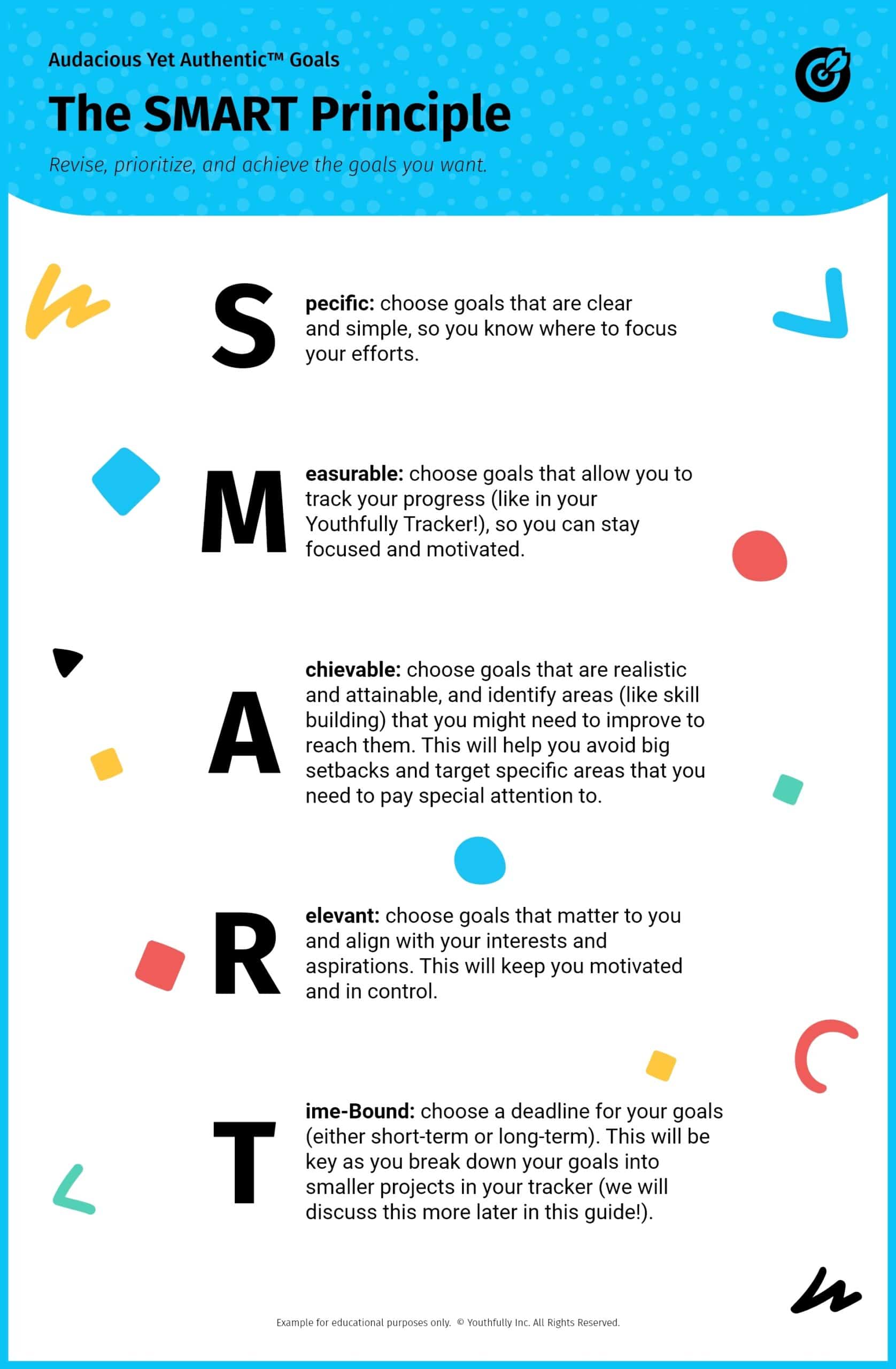
The SMART framework is one way to help students check whether their goals are clear and practical. The letters commonly stand for Specific, Measurable, Achievable, Relevant, and Time-bound.
- Specific: What skill or outcome will I work on?
- Measurable: What evidence will show progress?
- Achievable: Is the goal realistic with the time and support available?
- Relevant: Why does this goal matter for my learning?
- Time-bound: When will I review or complete it?
For example:
“I will improve my understanding of multiplication by completing three short practice sessions each week and reviewing my accuracy with my teacher after two weeks.”
This goal identifies the skill, the actions, a measure of progress, and a review date.
SMART goals should be used flexibly. A goal can be meaningful even if the student cannot predict every detail at the beginning. Teachers should help students refine their plans as they learn more about the task.
4. Break Long-Term Goals Into Smaller Steps
A long-term target can feel overwhelming if students cannot see what to do next. Teachers can make it more manageable by breaking it into short-term goals.
For example, a student who wants to write stronger essays might use this sequence:
- Identify the main argument in a sample essay.
- Practise writing a clear thesis statement.
- Organize supporting points into a simple outline.
- Write a paragraph using evidence.
- Draft a complete essay.
- Revise the essay using teacher feedback.
Each step builds toward the larger goal and provides an opportunity to recognize progress.
Short-term milestones are particularly helpful for students who become discouraged by large assignments. Teachers can show students how to estimate the time needed for each step and adjust the plan if it proves unrealistic.
5. Let Students Participate in Choosing Their Goals
Goals are more meaningful when students understand the purpose behind them and have some input into the target. Teachers should explain curriculum expectations, share relevant evidence, and then involve students in choosing an appropriate next step.
A teacher might say:
“Your recent work shows that you understand the main events in a story. Let’s choose one skill that will help you take the next step. Would you prefer to work on identifying the main idea or explaining why a character made a decision?”
This approach provides structure without removing the student’s voice.
Student choice should be age-appropriate. Younger learners may choose between two or three teacher-prepared options, while older students may be able to analyze their work and propose a goal independently.
Teachers should also check that the goal is appropriately challenging. A goal that is too easy may not lead to meaningful growth, while one that is far beyond the student’s current level can create frustration.
6. Teach Students to Create an Action Plan
A goal explains the intended outcome. An action plan explains what the student will do to move toward it.
Help students answer five questions:
- What will I practise or complete?
- When and how often will I do it?
- What resources or support will I need?
- What obstacles might make the plan difficult?
- What can I do if I get stuck?
For example, a student working on reading fluency might plan to read aloud for ten minutes on four days each week, use teacher-selected texts, and record unfamiliar words. If a passage is too difficult, the student can choose a more appropriate text or ask the teacher for guidance.
Encourage students to identify obstacles without treating them as excuses. A student who has limited quiet study time at home may need a school-based practice opportunity. A student who does not understand the assignment may need clarification before they can begin.
An effective plan accounts for the student’s circumstances and available resources.
7. Monitor Progress Through Regular Check-Ins
Goal setting is more useful when students revisit their goals instead of writing them once and forgetting them.
Teachers can schedule brief check-ins weekly or at another interval that fits the task. During these conversations, ask students to review their evidence, describe what is working, and decide whether any adjustments are needed.
Useful check-in questions include:
- What have you done toward your goal?
- What evidence shows progress?
- Which strategy has helped most?
- What has been difficult?
- What is the next small step?
- Do you need additional help or resources?
Students can track progress in a notebook, a checklist, a learning journal, a portfolio, or a simple digital document.
The purpose of monitoring is to guide learning, not to create unnecessary paperwork or punish students for missing a target. If progress is limited, the teacher and student should examine the plan and support available before deciding what to change.
8. Provide Specific Feedback and Celebrate Improvement
Feedback helps students understand which actions are effective and what they should do next. General praise such as “Great work” may feel encouraging, but specific feedback gives students more information about their learning.
For example:
- “You used the feedback from your last essay to organize your argument more clearly.”
- “You checked your calculations and corrected two errors independently.”
- “Your reading summary includes the main idea and details that support it.”
- “You completed each practice session you planned. Let’s look at what that practice helped you improve.”
Celebrate meaningful progress without comparing students publicly. Students begin at different levels and may need different amounts of time to develop the same skill.
Teachers can recognize persistence, effective strategy use, thoughtful reflection, and willingness to seek help—not only final scores.
Examples of Academic Goals for Different Subjects
Students may need examples before they can write their own goals. The following ideas can be adapted to the student’s current level, curriculum, and learning needs.
Reading goals
- Identify the main idea and supporting details in a short passage.
- Learn and use five new subject-related words each week.
- Summarize a chapter in a few sentences.
- Support an interpretation of a story with evidence from the text.
Writing goals
- Write a paragraph with a clear topic sentence and relevant details.
- Use a planning outline before starting a longer assignment.
- Revise a piece of writing using a teacher-provided checklist.
- Check punctuation and sentence structure before submitting work.
Mathematics goals
- Practise a specific type of problem several times a week.
- Explain the steps used to solve a word problem.
- Review incorrect answers and identify the source of each error.
- Choose an appropriate strategy when solving a multi-step problem.
Science goals
- Use observations to explain the result of an experiment.
- Record data clearly in a table or chart.
- Distinguish between a prediction and an observation.
- Support a scientific explanation with evidence from a classroom investigation.
Study and organization goals
- Record assignments in a planner each school day.
- Break a large project into smaller tasks with deadlines.
- Begin preparing for a test several days before the assessment.
- Ask for clarification when instructions are unclear.
- Review teacher feedback before starting the next similar assignment.
These examples are starting points. Teachers should help students select goals that address their actual learning needs rather than assigning the same target to everyone.
How to Adapt Academic Goal Setting for Different Age Groups
The amount of guidance students need depends on their age, prior experience, and ability to reflect on their learning. Goal setting should become more independent gradually.
Elementary school students
Young learners often benefit from one short-term goal, simple language, visual reminders, and frequent encouragement.
Teachers can use:
- Picture-based goal cards.
- Simple “I will” statements.
- Weekly checklists.
- Stickers or progress charts used privately or for personal reflection.
- Short conversations about what the student learned.
For example: “I will read for ten minutes during reading time and tell my teacher the main idea.”
Avoid setting too many goals at once. Help students understand that progress comes from practising specific skills and asking for help when needed.
Middle school students
Middle school students can begin connecting daily habits with longer-term learning outcomes. They may be ready to monitor progress more independently and reflect on which strategies work best.
Teachers can introduce:
- Subject-specific goals.
- Weekly progress logs.
- Revision plans.
- Reflection journals.
- Student-teacher goal conferences.
For example: “For the next three weeks, I will review my mathematics notes twice a week and complete a short set of practice problems before the weekly quiz.”
Help students balance goals across subjects so that one target does not create an unrealistic workload.
High school students
High school students can take a more active role in setting goals linked to subject mastery, independent learning, major projects, and future plans.
Teachers can support them with:
- Semester learning goals.
- Assignment milestones.
- Exam preparation schedules.
- Rubrics and self-assessment.
- Portfolios that show development over time.
- Reflection on the connection between strategies and results.
For example: “Before submitting my next research paper, I will review the assignment rubric, check the credibility of my sources, and revise the structure based on teacher feedback.”
Older students should also learn to revise goals when their priorities, available time, or understanding of the task changes.
How Teachers Can Help Students Overcome Goal-Setting Challenges
Not every goal will be achieved on the original schedule. Students may lose motivation, underestimate the time required, or discover that their first strategy is ineffective. These situations can become opportunities to practise planning and problem-solving.
When a student chooses a goal that is too broad
Help the student identify one skill or behaviour that can be addressed first.
Instead of “I want to be good at English,” the student might focus on writing clearer topic sentences or learning vocabulary for a particular unit.
When a student sets an unrealistic goal
Discuss the evidence, available time, and steps required. Help the student keep the long-term ambition while choosing a more manageable short-term milestone.
The purpose is to make the goal achievable through a meaningful plan, not to discourage ambition.
When a student loses motivation
Revisit why the goal matters and ask whether it still feels relevant. Break the next step into a smaller action, review progress already made, and identify any barriers that need to be addressed.
Students may also need a different learning strategy, more frequent feedback, or additional support.
When a student does not meet a deadline
Avoid assuming that the student is careless or unwilling to learn. Ask what happened, what the student learned from the experience, and how the plan could be improved.
The student may have underestimated the task, faced competing responsibilities, or needed help that was not available. The next plan should address the cause rather than simply add pressure.
When students compare their goals with classmates
Remind students that academic goals should reflect individual learning needs. One student may be working toward mastery of a foundational skill while another is ready for a more advanced challenge.
Celebrate personal growth and avoid public rankings that make students feel that their goals are less valuable because they differ from those of their peers.
A Simple Academic Goal-Setting Template for Students
Teachers can use the following template during a classroom activity, individual conference, or weekly reflection.
My academic goal
- The skill I want to improve: What do I want to learn or do better?
- My starting point: What can I currently do? What evidence helps me understand my progress?
- My goal: What specific improvement am I working toward?
- My action steps: What will I practise or complete?
- My timeline: When will I work on the goal, and when will I review it?
- My resources: What materials, feedback, or support will I need?
- Possible obstacles: What might make this difficult?
- My plan for obstacles: What can I do or whom can I ask for help?
- My progress evidence: How will I know whether I am improving?
- My reflection: What worked, what did not, and what should I do next?
Completed example
Student: A middle school learner working on reading comprehension.
Goal: Over the next three weeks, I will improve my ability to identify the main idea and supporting details in a grade-level passage.
Action steps:
- Read one short passage during each planned practice session.
- Write the main idea in one sentence.
- Identify two supporting details.
- Compare my response with teacher feedback.
- Review my progress at the end of each week.
Progress evidence: A collection of practice responses and feedback showing whether the student can identify main ideas and supporting details more consistently.
Possible obstacle: Some passages contain unfamiliar vocabulary.
Plan: Mark unfamiliar words, use context clues, and ask for help when the meaning remains unclear.
Review question: Which strategy helped me understand the passage most effectively?
This example can be adjusted for mathematics, writing, science, homework completion, or other learning priorities.
How Schools Can Make Goal Setting Part of Everyday Learning
Goal setting is most useful when it becomes a regular part of teaching rather than a one-time activity at the beginning of the school year.
Connect goals to lesson objectives
At the start of a lesson or unit, explain what students are expected to learn. Help them identify a personal next step that aligns with that learning objective.
For example, after explaining the criteria for a persuasive paragraph, students can choose whether to focus on writing a clearer claim, selecting stronger evidence, or organizing their ideas.
Use formative assessment to guide goals
Short quizzes, exit tickets, classroom discussions, drafts, and teacher observations can help students understand what they can do and what they need to practise.
The goal should respond to actual evidence rather than a general impression of ability. Pakistan’s National Curriculum Council describes assessment for learning as a way to monitor progress toward learning goals and provide descriptive feedback that helps students improve.
Schedule brief goal conferences
A short conversation can help a student clarify a goal, review progress, or request assistance. Teachers do not need a lengthy meeting with every student every week; they can use rotating check-ins, small-group discussions, or short written reflections.
Involve families when appropriate
Families can reinforce school goals by asking about progress, helping students maintain reasonable routines, and encouraging them to seek help when needed.
Share goals and progress in a constructive way. Avoid making family communication feel like a warning or a demand for perfect results.
Make support part of the plan
Students should know where to get help if they struggle. Depending on the goal, support may include teacher feedback, additional practice, peer collaboration, tutoring, accessible learning materials, or a meeting with school support staff.
Goal setting should help students access support—not make them feel that every outcome depends on individual effort alone.
How to Know Whether Student Goals Are Working
Teachers can evaluate the goal-setting process by looking at both learning outcomes and the strategies students use to make progress.
Useful indicators include:
- Improvement in the targeted skill.
- More consistent completion of planned practice.
- Better use of feedback.
- Greater ability to explain what needs improvement.
- More realistic planning and time management.
- Increased independence in choosing next steps.
- Willingness to revise a strategy when it is not working.
No single measure tells the whole story. A student may make meaningful progress even if the original target is not fully achieved by the review date.
Teachers should use evidence to decide whether to continue the goal, change the strategy, adjust the timeline, or provide additional support. The Australian Education Research Organisation’s guide to supporting self-regulated learning offers further guidance on teaching students to plan, monitor, and evaluate their learning.
Common Goal-Setting Mistakes Teachers Should Avoid
Even a well-intentioned goal-setting activity can become less effective if it is not connected to practical support.
Setting too many goals at once: Multiple priorities can overwhelm students. Begin with one or two meaningful targets and add more when appropriate.
Using goals that are too vague: “Try harder” does not explain what a student should do. Define the skill, the action, and the evidence of progress.
Making every goal about grades: Grades can provide useful information, but goals can also focus on understanding, strategy use, organization, persistence, or independent work.
Setting goals without student input: Students may be less engaged if they do not understand why a target matters. Involve them in choosing a relevant next step.
Ignoring obstacles: A student may need more time, resources, clarification, or additional instruction. Discuss these factors before deciding that the student has failed to follow the plan.
Checking progress only at the end: Regular reviews allow students to change ineffective strategies before too much time passes.
Comparing students publicly: Each student’s starting point and support needs are different. Use goals to track individual progress, not to create a classroom competition.
Treating missed goals as personal failure: A missed target is information that can help improve the plan. Discuss what happened and agree on the next step.
Frequently Asked Questions
What is academic goal setting for students?
Academic goal setting is the process of identifying a learning target, planning actions to reach it, and reviewing evidence of progress. It helps students understand what they want to improve and what steps they can take next.
How can teachers help students set realistic academic goals?
Teachers can review student work, discuss strengths and learning needs, help students choose specific targets, break larger goals into smaller steps, and set a reasonable timeline. They should also check that students have the time, resources, and support needed to work toward the goal.
What are examples of academic goals for students?
Examples include identifying the main idea in a reading passage, improving the structure of an essay, practising a mathematics skill three times a week, submitting assignments on time, or using teacher feedback to revise a project.
How often should students review their academic goals?
The schedule depends on the goal. A short-term classroom goal may be reviewed weekly, while a larger project or semester goal may need regular milestones. Students should review goals often enough to identify progress and adjust their strategies.
Should students set their own academic goals?
Students should have a voice in setting their goals, but the level of independence should match their age and needs. Teachers provide curriculum expectations, evidence, and guidance while helping students select an appropriate next step.
What should teachers do when students do not reach their goals?
Teachers should help students examine the evidence, identify obstacles, and review whether the goal or strategy was realistic. The next step may be more practice, a different learning method, a revised timeline, or additional support.
How does academic goal setting support independent learning?
It gives students practice identifying learning needs, planning actions, monitoring results, using feedback, and deciding what to do next. Over time, these habits can help students manage more of their learning independently.
Conclusion
Helping students set academic goals is about more than asking them to write down what they want to achieve. It involves teaching them to understand their current performance, choose a meaningful target, plan manageable actions, monitor evidence, and reflect on the results.
Teachers can make the process practical by modelling goal setting, involving students in decisions, providing specific feedback, and creating regular opportunities to review progress. Goals should be challenging enough to encourage growth while remaining realistic in light of each student’s needs and available support.
When academic goal setting for students becomes part of everyday classroom learning, students can develop stronger planning habits, a clearer understanding of their progress, and greater confidence in taking the next step. Start with one specific learning goal, agree on a simple action plan, and schedule a time to review what the student learns along the way
