
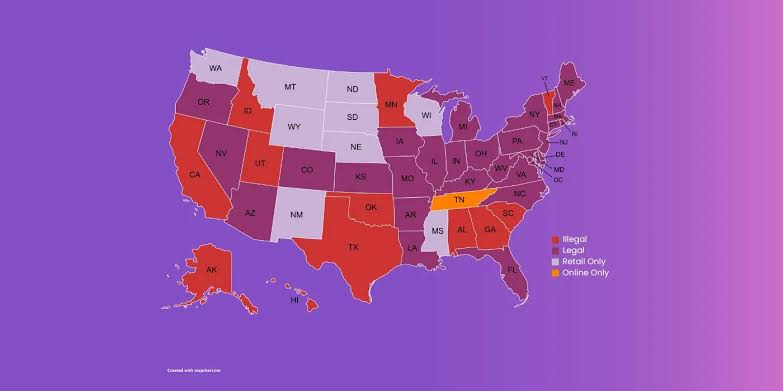
Online sports betting has expanded across the United States since a 2018 U.S. Supreme Court decision allowed states to set their own sports wagering laws. Today, online sportsbooks are legal in many states and the District of Columbia, but the rules vary by location. Some jurisdictions allow mobile betting statewide, others restrict betting to specific venues or tribal operators, and some prohibit conventional sports betting altogether.
States Where Online Sports Betting Is Legal
As of October 2026, online sports betting is operational in 31 states and Washington, DC. The following jurisdictions allow online or mobile sports wagering through authorized operators, subject to local rules. Florida has a limited market, while Nevada has specific registration requirements.
- Arizona
- Arkansas
- Colorado
- Connecticut
- Delaware
- Florida
- Illinois
- Indiana
- Iowa
- Kansas
- Kentucky
- Louisiana
- Maine
- Maryland
- Massachusetts
- Michigan
- Missouri
- Nevada
- New Hampshire
- New Jersey
- New York
- North Carolina
- Ohio
- Oregon
- Pennsylvania
- Rhode Island
- Tennessee
- Vermont
- Virginia
- West Virginia
- Wyoming
- Washington, DC
This list refers to markets where online wagering is available, not merely where a law has been passed. Wisconsin, for example, legalized online sports betting in 2026, but its statewide market had not yet launched as of October 2026.
Where to Check State-by-State Betting Laws
Because sports betting laws can change, it is important to verify the current legal status before using an online sportsbook. Official state gaming regulators provide information about authorized operators and applicable restrictions.
For a state-by-state overview of U.S. sports betting regulations and available betting options, TrustNB et provides a dedicated guide.
For a complete state-by-state overview of betting laws and available options, see the sports betting legal states guide.
The overview can help readers identify the rules that apply in individual states and the District of Columbia. For legal confirmation, consult the relevant state regulator, particularly when legislation has recently changed.
States Where Online Sports Betting Is Not Legal
Several states have not authorized conventional online sportsbooks. These include:
- Alabama
- Alaska
- California
- Georgia
- Hawaii
- Idaho
- Minnesota
- Oklahoma
- South Carolina
- Texas
- Utah
Other states permit certain forms of in-person sports wagering but do not offer conventional statewide online sportsbook apps. The availability and scope of permitted betting depend on state laws and, in some cases, tribal gaming agreements.
How Online Sportsbook Laws Work
Each state sets its own rules for online sports betting. These can cover the minimum legal betting age, licensing requirements, eligible sports and events, taxes, advertising, and responsible gambling.
Most regulated markets require bettors to be at least 21, although age requirements vary by jurisdiction. Online sportsbooks generally use geolocation technology to confirm that customers are physically located within an authorized area. A sportsbook licensed in one state does not automatically have permission to accept bets in another.
OSB in the US Summed Up
Online sports betting is available in 31 states and Washington, DC, as of October 2026, but it is not legal everywhere. Some states permit only limited in-person betting, while others prohibit conventional sports wagering. Newly passed laws may also take effect before a market actually launches.
The key point is that online sportsbook legality is determined by the bettor’s physical location and the rules of that jurisdiction. Checking the latest state regulations and using only authorized operators helps clarify which options are legally available.
For additional nationwide information, visit the American Gaming Association at https://www.americangaming.org. It provides a useful industry overview, although it is not a government regulator.
